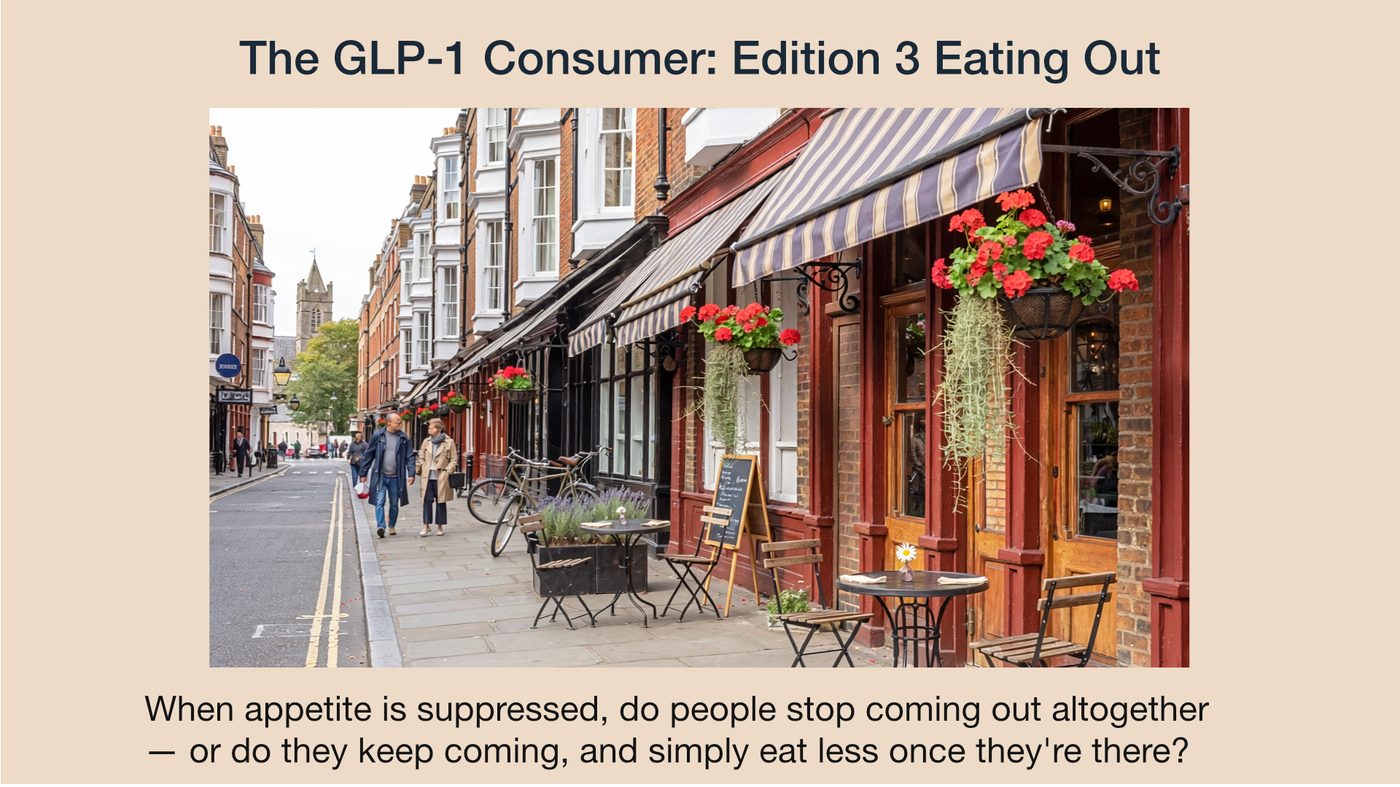
For hospitality, this is the question that matters more than almost any other: when appetite is suppressed, do people stop coming out altogether — or do they keep coming, and simply spend less once they're there?
On the evidence of 22 posts and 427 comments read in full across five UK and international Reddit communities, the answer is reassuring and uncomfortable in roughly equal measure. People are still coming. They are eating, and spending, very differently once they arrive.
The portion that never used to exist
The single most consistent change at the restaurant table is that portion size stops being something posters have to think about. A meal that would once have been eaten in one sitting now routinely stretches across two, three or more, without any sense of denial.
My portions are so much smaller now! Went out to dinner last weekend and ordered a delicious seafood pasta dish… Those leftovers became lunch the next day (meal 4 and 5). I could not have fathomed this 1 year ago!
That single mechanism is doing most of the work in this edition. It's why the bill drops, why the menu-strategy conversation exists, and why the highest-stakes moments — holidays, Christmas — turn out to be more manageable than the headline forecasts would suggest.
The bill drops, and posters are doing the maths themselves
A recurring, almost accountant-like observation is that eating out now costs less overall — smaller portions, skipped starters and desserts, less drinking — enough, several posters argue, to offset a meaningful share of the cost of the medication itself.
People talk about the cost of this medication I'm like do the maths / everytime I go out, I get two meals out of it, and I don't get appetisers or desert and order one of any drinks …it's a wash for me.
For operators, that's the uncomfortable half of the answer: footfall may hold up far better than a simple “appetite suppression will empty restaurants” forecast implies, but average spend per cover on this segment is under real, structural pressure.
A crowd-sourced menu strategy already exists, and it's worth reading
A distinct, highly practical seam of this conversation is devoted to which restaurants, chains and dishes work well on a suppressed appetite and slowed digestion — read less like diet advice and more like a community-maintained reference guide, built dish by dish.
I love the ‘small plates’ concept that is in so many restaurants now as it allows me to have a little of a variety of delicious food… In maintenance, I've even got to the point of thinking ‘nah, not worth it as I can make it better at home’.
That last line is the one worth sitting with. Small-plates and shareable formats are already the preferred structure for this diner — and the alternative, if a venue doesn't offer it, isn't a smaller order. It's not coming at all.
Holidays are the real stress test, and the outcome depends on one thing
Nothing in this data tests the whole arrangement — dosing, appetite, social pressure — as hard as a holiday. Outcomes range from effortless moderation to full relapse, and the difference consistently comes down to one variable: whether the person is still actively medicated and adjusting their dose around the trip, or has come off treatment and is relying on habit alone.
With all the food and drink available, control I felt was going to be my issue… I still have an issue with overeating and food noise, the reality for me is that I may need this drug long term to battle my brain.
I took my pen on an all inclusive week to Turkey. I was less strict on myself but didn't let myself go mad… I gained 5lb but that disappeared within the following week so was mostly water retention from flying.
Christmas dinner, tested directly in the data via a dedicated forum megathread, turns out to be one of the easier occasions to manage of all — moderation without any sense of deprivation, repeatedly described by posters as “freeing” rather than restrictive.
What's genuinely at risk is the social ritual, not the reservation
Set against that confident moderation, a smaller but candid group of posts describes real friction — not because the food is a problem, but because so much of social life is organised around meals the poster can no longer meaningfully take part in the way others expect.
I feel this. I miss the socialising, and just can't do it… I skip our weekly dinners to go to the gym and I skip business lunches to eat at my desk… people, understandably prefer margaritas and wings.
Alcohol is where this friction is sharpest and most physically obvious — reduced tolerance turning up mid-evening, in public, in a way appetite changes rarely do.
I'm out for a few drinks (within my calories) and couldn't finish my second bottle of cider. So I moved to wine. Still can't drink it! … it screws my social life.
For hospitality and drinks brands specifically, that's the line item most exposed in this entire report — not the cover count, but what's ordered once people are seated.
A live disagreement about whether any of this is worth mourning
Running underneath everything else in this edition is a genuine, unresolved split in the community. One camp frames the retreat from food-and-drink-centred socialising as a loss to be actively managed. The other frames it as the removal of a burden they didn't realise they were carrying.
I actually really hate this mentality and I truly don't understand it at all… A few weeks ago I was doing an itinerary for our next holiday and realised when I'd finished it that I'd actually forgotten to plan meals at all. Not one. It hadn't even occurred to me. It's so incredibly freeing.
Both positions are argued fluently, at length, and with strong community support — which suggests this is a stable, ongoing feature of how this consumer thinks about going out, not a passing mood.
Closing thought
Hospitality's fear scenario — suppressed appetite emptying the dining room — isn't what this data shows. People are still going out, still marking occasions, still managing Christmas without apparent difficulty. What's genuinely shifting is what they order once they arrive, how much they drink, and how many of the old social rituals survive the change intact. That's a survivable problem for operators who adapt their formats towards small plates and protein-forward options. It's a much harder one for anyone relying on the second bottle of wine.
Follow along
That closes the first full pass through all three themes. From here, we'll continue tracking clothes, food at home and eating out on the same fortnightly cadence — and periodically step back for the “across the wallet” view, tracing where the freed-up spending actually goes once it leaves one category.
Follow the series, and do get in touch if you'd like the full tracker for this edition — or simply a conversation about what it means for your category.