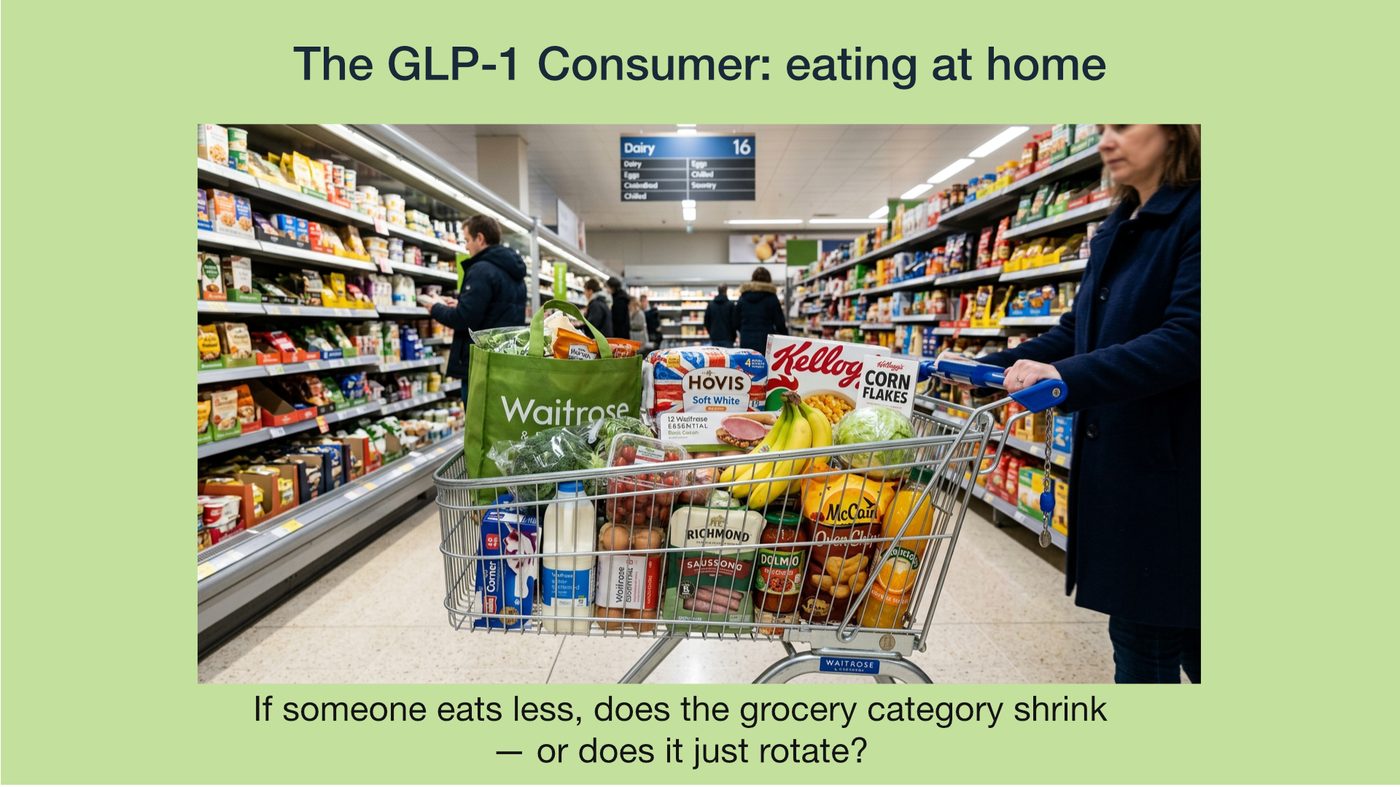
If someone eats less, does the grocery category shrink — or does it just rotate?
That's the question we set out with for this edition, and it's the biggest theme in our data, for the simple reason that it's the one FMCG has the most at stake in. This edition is a three-month pulse rather than our full historical read: it looks only at the 496 posts and 2,737 comments posted in the last three months (29 April to 28 July 2026), so we can see what's live right now rather than the cumulative picture. The answer, on that evidence, is: both — but not evenly, and not where you might expect.
The mechanism behind almost everything else
Nearly every other change in this data traces back to one thing, named by users themselves, unprompted, over and over: “food noise” — the constant background chatter of thoughts about food — going quiet. Once that happens, a chain of consequences follows through the weekly shop, the fridge, and the drinks cabinet.
Yes. Food noise ruled my life. I am at peace now.
r/MounjaroMaintenance, May 2026
It's worth sitting with that mechanism for a moment before getting to the category detail, because it explains why this isn't simply a story of smaller portions. It's a story of reduced interest in food as a category of purchase in the first place.
The weekly shop gets smaller, and the bill drops with it
Supermarket behaviour is one of the most consistently reported changes in the whole sample. A previously pleasurable, habit-driven activity becomes confusing or actively unappealing — with a direct, welcomed effect on spend.
I used to love going to the supermarket… Now I feel like a vegetarian in the butchers shop when in the supermarket. Thinking “I don't fancy that, I don't fancy that either”. My bill has dropped considerably, and probably goes a long way towards the monthly payments.
r/mounjarouk, July 2026
That last line recurs in different words across dozens of posts: people describing the medication as partly self-funding, because the household food bill has fallen enough to notice. For grocery retail, that's a real, quantifiable headwind sitting inside a category that isn't shrinking for any of the usual reasons — no recession, no price story, just reduced appetite for buying in the first place.
Rotation, not just shrinkage: protein and whole foods are the winners
Where spending continues, its composition shifts. Multiple posters describe an unplanned, almost accidental move away from processed food, meat and ready meals towards vegetables, legumes, eggs and lean protein — several use the word “vegetarian” to describe a change they didn't consciously choose.
Mounjaro has given me back my love of healthy vegetarian food and I now eat to nourish myself, not destroy myself.
r/mounjarouk, July 2026
But this rotation comes with a genuine complication for the people living it: appetite suppression makes it hard to eat enough protein to protect muscle mass during rapid weight loss, which has generated an entire crowd-sourced body of tactics — protein-first plates, dense easy-to-finish shakes, small servings spread through the day.
There is no better time to kick out processed foods and swap for whole foods than while your appetite is controlled for you. … Prioritise protein, high volume/low cal foods, and fibre. Add as much protein as you can — you need so much more than you think.
r/Mounjaro, July 2026
That's a genuine opportunity for anyone selling high-protein, easy-to-finish, small-format products — the category isn't just growing here, it's actively being asked for by people who are struggling to solve the problem themselves.
Sugar is the one thing that refuses to rotate away
If there's a single exception to the “less food noise, less interest in food” pattern, it's sugar. Posters who report a complete loss of interest in savoury food and large meals frequently describe an intact, sometimes intensified, pull towards sweet food specifically — and find it confusing precisely because it contradicts everything else the medication is doing.
Nothing sounds appetizing to eat except sweets… It's like nothing sounds good except chocolate or fruit snacks.
r/Mounjaro, September 2022
For confectionery and snacking brands watching this category with dread, that's a genuinely useful nuance: the broad snacking occasion is shrinking, but sugar-specific demand is proving stickier than everything around it — which changes where in the aisle the pressure is actually landing.
Alcohol goes two ways, and the direction shifts with time on the medication
Alcohol shows the clearest split in the whole dataset. The majority pattern is a sharp, usually welcomed, drop in desire and tolerance. A smaller, vocal minority — concentrated later in maintenance — describe the opposite: a rebound urge that several posters name, echoing “food noise”, the “wine voice”.
The biggest issue for me though is that the wine voice has reared its ugly head… I am gaining weight and probably consuming about 50% of my calories from wine.
r/mounjaromaintenanceuk, June 2026
Read against the earlier, near-universal drop in interest, this looks less like a category in permanent decline and more like a category whose demand curve bends back upward the longer someone stays on the medication — a genuinely different planning problem to a simple, one-way volume loss.
Stress still breaks through, briefly
Across otherwise well-controlled accounts, sudden stress — bereavement, illness, a missed dose — reliably triggers a short, intense return of old eating patterns, almost always followed by guilt and a fast return to control, rather than any lasting change of course.
My mum died last week… This last week, I have not stopped eating. I don't mean an extra biscuit. I mean binging morning, noon, and night. I can't stop.
r/mounjaromaintenanceuk, July 2026
These episodes are genuinely brief in the data — days, not weeks — but they're a reminder that the category isn't being permanently vacated so much as occupied more intermittently, with real spikes still possible around acute life events.
Two things we didn't see the first time round
A much bigger read of the same communities surfaced two patterns invisible in our first edition. The first is a straightforward flavour problem, not an appetite one: some users report food and drink genuinely tasting different — coffee turning undrinkable, chocolate turning artificial — which is a distinct threat to habitual, brand-loyal categories that portioning or reformulation alone won't fix.
I just started Mounjaro about a month ago… one particular food, Ground Beef, is starting to taste awful to me. … it tastes SO beefy/gamey that I can't even stomach it!
r/Mounjaro, July 2026
The second is a household effect. Most of what we read is written from the point of view of the person on the medication — but a growing minority of posts come from partners and parents, describing shopping and cooking that used to be shared now falling to one person by default.
I am getting frustrated with meal times (planning, shopping, cooking, and sitting down to eat) always being my responsibility and effort where it used to be a shared effort. … 'don't worry about me - I'm not hungry'.
r/Semaglutide, July 2026
Neither of these shows up if you're only counting how much less someone is eating. Both matter for anyone planning around the assumption that a household's food decisions move together.
Closing thought
The grocery story in this three-month window isn't decline. It's redistribution, with one stubborn holdout and two twists a smaller or longer-range sample would miss. Protein, fresh produce and easy-to-finish, high-protein formats are being actively pulled towards by people who are struggling without them; snacking and confectionery are genuinely shrinking, except where sugar specifically is concerned; alcohol looks less like a straight-line loss than a curve that may bend back the longer someone stays on treatment; and taste change and household spillover are two consumer signals worth tracking in their own right, not just noise around the edges of the appetite story.
As with every edition in this series, we'll re-read the same communities at our next regular update against the same themes, rolling the three-month window forward to see whether the sugar exception and the alcohol rebound are hardening into a pattern or were simply what this particular window happened to surface.
Follow along
Next edition: eating out — and whether people suppressed on appetite stop coming to restaurants, or keep coming and simply spend less.
Follow the series, and do get in touch if you'd like the full tracker for this edition — or simply a conversation about what it means for your category.